GSEP's Kevin Wong Co-Edits Global Book Series Reimagining Multilingual Learning
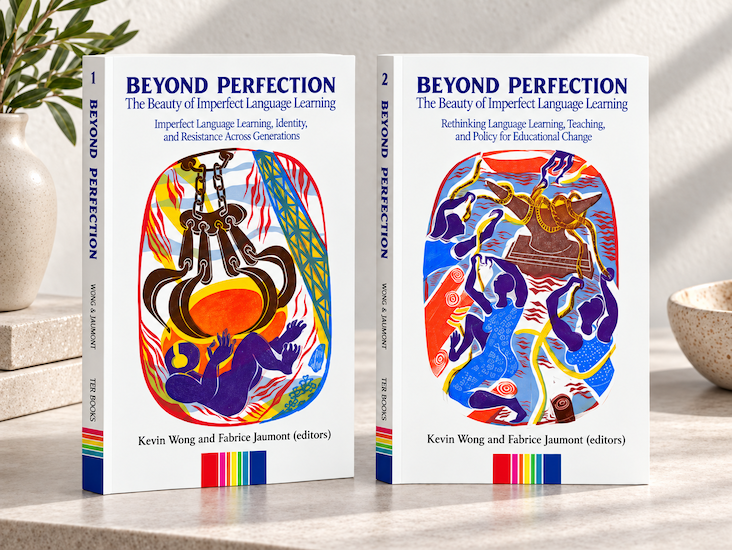
Kevin M. Wong, associate professor of education and chair of the MA in TESOL program at Pepperdine University’s Graduate School of Education and Psychology, has co-edited a new two-volume series that invites educators, researchers, and families to reconsider what successful language learning looks like.
Published by CALEC–TBR Books, Beyond Perfection: The Beauty of Imperfect Language Learning challenges narrow definitions of fluency, correctness, and native-like mastery. Across 40 chapters, the series presents multilingualism as an adaptive and deeply human experience—one shaped by family, migration, memory, identity, education, and belonging.
Wong edited the collection with Fabrice Jaumont. The two volumes feature 65 contributors representing more than 38 higher education institutions. Contributors are currently based, studying, or working in at least 14 countries, while their personal and professional experiences span more than 25 countries.
“This project is deeply connected to questions that have followed me across much of my life,” Wong said. “My relationship with language has always been deeply personal.”
Raised in a multilingual and multicultural home in Hong Kong, Wong studies language learning and heritage-language maintenance, drawing upon his experiences as a researcher, educator, parent, and speaker of English, Cantonese, and Mandarin.
“I know what it feels like to reach for words that carry family, memory, culture, and belonging, and to feel the distance when those words do not come as easily as I wish they would,” he said.
The series brings together researchers and professors, K–12 teachers, school and district leaders, teacher educators, speech-language pathologists, nonprofit leaders, writers, parents, and community practitioners. Their work spans bilingual and multilingual education, literacy, translanguaging, heritage-language education, artificial intelligence, digital literacy, neurodiversity, special education, sociolinguistics, and educational policy.
Volume 1, “Imperfect” Heritage Language Learning, Identity, and Resistance Across Generations, examines family language transmission, migration, memory, multilingual parenting, identity, and the recovery or reclamation of heritage languages. Through personal narratives and community-centered research, contributors explore what it means to live between linguistic worlds and to pass languages from one generation to the next.
Volume 2, Rethinking Multilingual Teaching, Learning, and Policy for Educational Change, focuses on classrooms, communities, teacher education, and public policy. Its chapters question familiar assumptions such as the “balanced bilingual,” the native-speaker ideal, and the strict separation of languages in schools. Contributors instead emphasize student agency, community knowledge, care, belonging, and the value of hybrid language practices.
For Wong, these perspectives reveal forms of knowledge and creativity that conventional measures of language proficiency can overlook.
“Over the years, I have watched children, families, teachers, and communities navigate their own complicated relationships with language, often carrying far more knowledge, creativity, and linguistic possibility than conventional measures allow us to see,” he said. “That tension lays the foundation for this work, which envisions a dynamic, living multilingualism that exists beyond confining ideals of perfection.”
Beyond Perfection: The Beauty of Imperfect Language Learning is available in hardcover, paperback, and eBook formats through CALEC–TBR Books.
SUBSCRIBE TO THE WAVELENGTH
Pepperdine Newsroom's official newsletter for campus updates and top news.
Subscribe